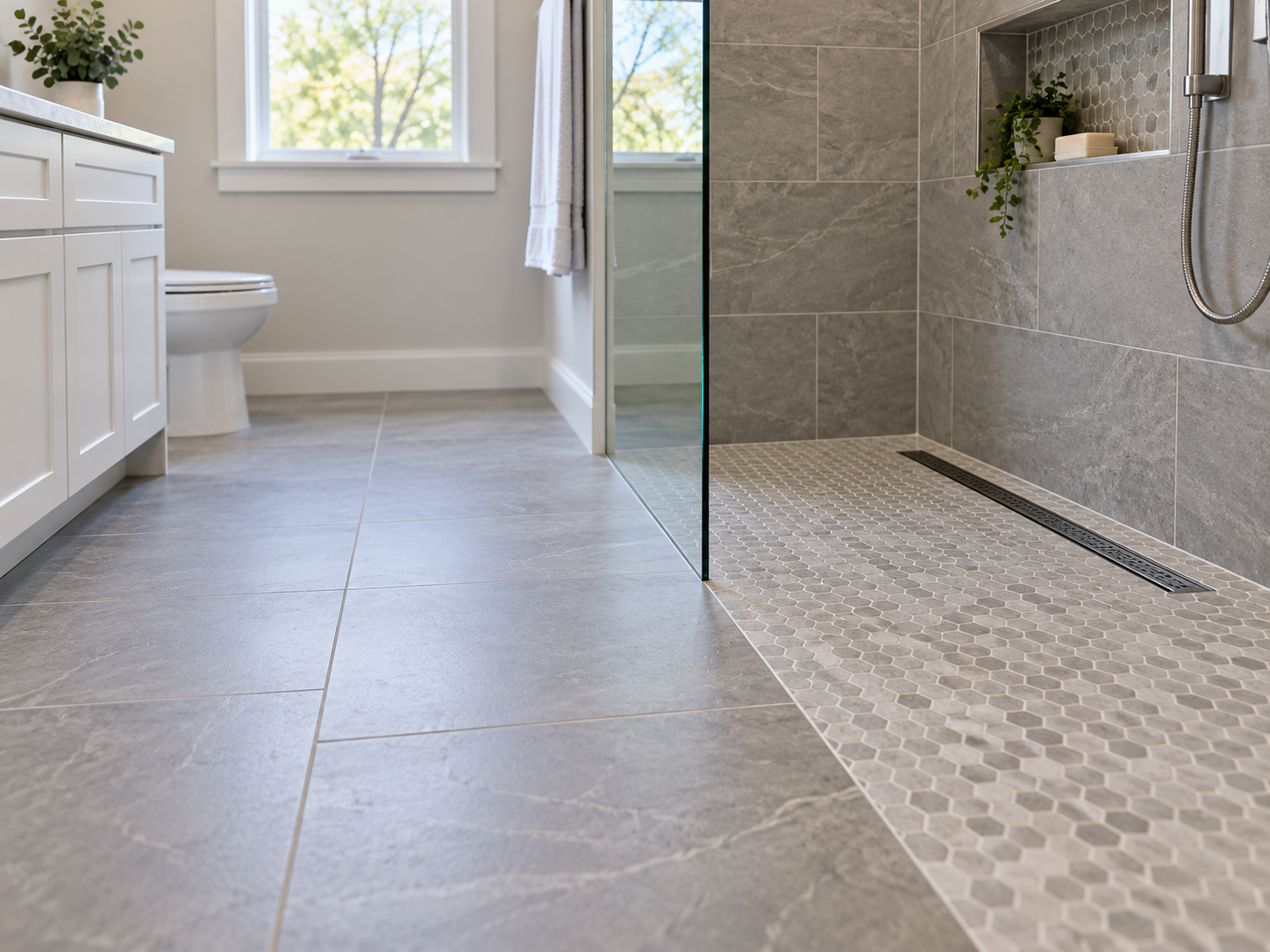
Bathroom floor tile has to do more than look good. It has to be safe to walk on with wet feet, stand up to water and cleaning products, and suit the sub-floor underneath it. In Hunting-don Valley, Abington and the surrounding Montgomery County suburbs, many bathroom remodels replace original 1960s and 1970s floors, and the choices available now are far wider than they were then.
This guide covers how slip resistance is measured, how porcelain, ceramic and natural stone compare, why tile size and finish change how a floor performs, and what to plan before tile is ordered.
Slip Resistance: What DCOF Means
The most useful number for comparing bathroom floor tile is the wet DCOF, or dynamic coefficient of friction. It measures how much resistance a surface offers to a moving foot when wet.
Manufacturers test tile using the ANSI A326.3 method. As Daltile explains, ANSI A137.1 requires tile flooring recommended for level interior spaces that will be walked on when wet to have a DCOF of 0.42 or greater, measured according to ANSI A326.3.
A few practical points:
•Look for the wet DCOF on the product data sheet. Many manufacturers also list a product use classification such as “Interior, Wet.”
•0.42 is a minimum benchmark, not a guarantee. Daltile notes that DCOF measurements should not be considered an indicator of whether a slip can occur.
•Polished and glossy finishes typically test lower. A high-gloss tile that looks beautiful on a wall may be a poor choice for a bathroom floor.
•Shower floors need extra attention. They are wet every day and often have soap residue.
Porcelain, Ceramic and Natural Stone Compared
Porcelain Tile
Porcelain is made from refined clay fired at high temperatures, producing a dense body with very low water absorption.
•Strengths: dense and hard-wearing, low water absorption, wide range of looks including stone and wood visuals, and many products rated for wet interior floors.
•Considerations: harder to cut, and large porcelain tiles need a very flat substrate.
Ceramic Tile
Ceramic tile is fired at lower temperatures and is generally more porous than porcelain, with a glaze providing the wear surface.
•Strengths: economical, easy to cut, and plenty of colors and shapes.
•Considerations: confirm the product is rated for floors; some ceramic tiles are intended for walls only.
Natural Stone
Marble, limestone, slate and granite each bring a natural look, but they behave differently from manufactured tile.
•Strengths: unique appearance and long history in traditional bathrooms.
•Considerations: many stones need periodic sealing. Marble and limestone can etch from acidic cleaners. Polished stone is slippery when wet, so honed or textured finishes are usually preferred on floors.
Tile Size and Shower Floors
Tile size changes both appearance and performance.
•Small mosaics on shower floors. More grout joints add traction underfoot, and small tiles conform more easily to the slope needed to direct water to the drain.
•Large-format tile on main floors. Fewer grout lines give a clean, modern look, but large tiles demand a flatter substrate to avoid lippage, where one tile edge sits higher than its neighbor.
•Linear drains. A linear drain lets the shower floor slope in one direction, which makes larger tiles workable in the shower.
The Subfloor Matters as Much as the Tile
Tile is rigid, and it will crack if the floor underneath flexes or moves. In older homes, the sub-floor under a bathroom is often damaged by years of small leaks around the toilet or tub. Before tile is selected, the remodeling team should:
•Inspect the sub-floor and joists for water damage and soft spots.
•Check for deflection, especially when switching to large-format tile or natural stone, which are less tolerant of movement.
•Install an appropriate underlayment or uncoupling membrane recommended by the tile and membrane manufacturers.
•Plan the finished floor height so the new floor meets the hallway cleanly, and confirm the toilet flange ends up at the right height.
Grout and Finish Choices
Grout is part of the floor’s performance:
•Cement-based grout is common and economical but benefits from sealing.
•High-performance and epoxy grouts resist staining and generally do not need sealing, though they require more skill to install.
•Grout color: mid-tone grout hides everyday dirt better than bright white on a floor.
Heated Floors and Tile
If you are considering radiant floor heat, choose the heating system before the tile. Electric mats are installed under the tile in the thinset or a membrane, and the floor height, thermostat location and dedicated circuit all need to be planned. Porcelain and stone both work well over radiant heat when installed to the manufacturer’s instructions.
Matching Tile to the Way You Use the Bathroom
•Family bathrooms used by children: prioritize a textured or matte finish rated for wet interior floors, with a forgiving grout color.
•Primary bathrooms with walk-in showers: coordinate the main floor and shower floor; mosaics in the shower with a matching larger tile outside is a common approach.
•Aging-in-place plans: choose higher-traction tile, minimize thresholds, and consider a curbless shower with a properly built slope.
•Powder rooms: lower water exposure gives you more freedom with decorative tile, though slip resistance still matters.
Questions to Ask Before You Order
1. What is the wet DCOF of this tile, and what use classification does the manufacturer assign?
2. Is it rated for floors, and for shower floors specifically?
3. What substrate flatness and underlayment does the manufacturer require for this tile size?
4. Does the stone need sealing, and with what product?
5. Which grout is recommended for this tile and location?
Frequently Asked Questions
What is the safest tile for a bathroom floor?
There is no single safest tile, but a good starting point is a product rated for level interior wet areas with a wet DCOF of 0.42 or higher, in a matte or textured finish. Small mosaics in the shower add traction through grout joints.
Is porcelain better than ceramic for bathroom floors?
Porcelain is denser and absorbs less water, which makes it a common choice for bathroom floors. A quality ceramic tile rated for floor use can also perform well.
Can I use marble on a bathroom floor?
Yes, but choose a honed rather than polished finish for better traction, and plan on sealing and using pH-neutral cleaners to avoid etching.
Do large tiles work in small bathrooms?
They can, and fewer grout lines can make a small room feel larger. Large tiles need a flat, stiff sub-floor and careful layout around the toilet and vanity.
Plan the Floor From the Subfloor Up
The right bathroom floor tile is the result of several decisions working together: slip resistance, material, size, grout and the structure underneath. Getting those right before ordering prevents cracked tiles, slippery floors and costly rework.
Hunting-don Valley Kitchen & Bath Remodelers LLC designs and builds bathroom remodels in Hunting-don Valley, Abington and nearby communities. Explore our bathroom remodeling services to start planning your new floor.