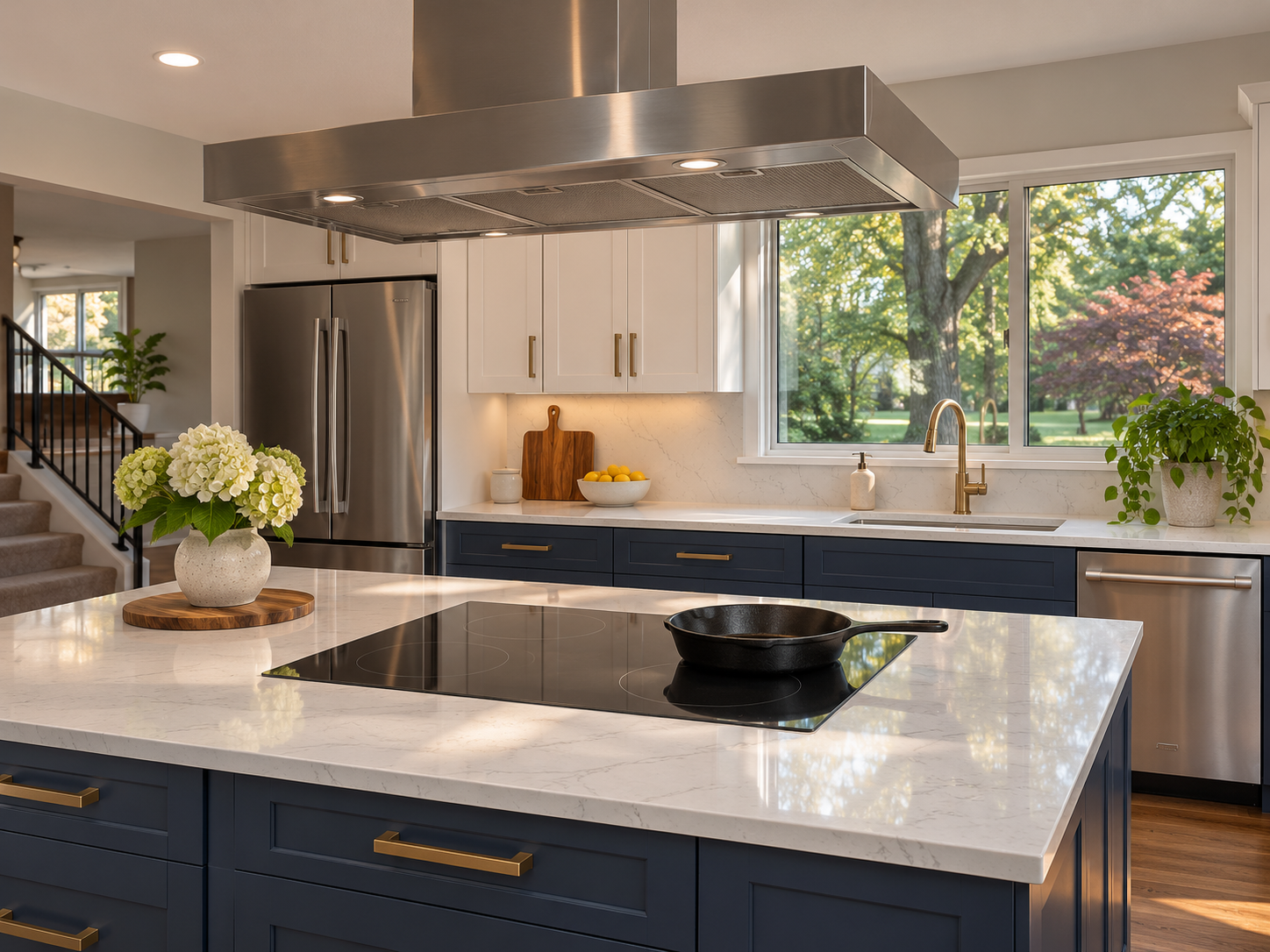
More homeowners in Huntingdon Valley, Meadowbrook, Bethayres and nearby Montgomery County towns are asking about induction when they plan a new kitchen. Some want faster cooking. Some want a cooler, easier-to-clean surface. Some are replacing an old gas range and want to know if this is the moment to switch. A kitchen remodel is the best time to make that decision, because the electrical work, cabinet layout and ventilation can all be planned together.
This guide explains how induction works, what it changes in the kitchen design, and what to settle with your remodeler before the cabinets are ordered.
How Induction Cooking Works
Induction cooktops do not heat the glass surface directly. As ENERGY STAR explains in its Emerging Technology Award summary on residential induction cooking tops, an electromagnetic coil creates a magnetic field, and compatible cookware placed in that field is warmed internally, transferring energy with approximately 85 percent efficiency. The same summary puts conventional gas and electric resistance cooktops at approximately 32 percent and 75 to 80 percent efficiency, respectively.
ENERGY STAR also notes that because the cookware itself is the heat source, the cooktop surface stays cooler to the touch, less heat escapes into the room, and pans reach temperature more quickly. For a busy family kitchen, those practical benefits often matter more than the efficiency numbers.
What Changes in the Kitchen When You Choose Induction
Switching to induction is not just an appliance swap. It affects several parts of the remodel.
Electrical service and circuits. Induction cooktops and ranges need a dedicated, properly sized 240-volt circuit. If you are moving from gas, there may be no suitable circuit in place. Your electrician will check:
- Whether the main panel has capacity for the new circuit.
- Whether other new loads, such as a wall oven, microwave drawer or heat pump, also need room in the panel.
- The wire size and breaker required by the appliance manufacturer.
- The route from the panel to the cooktop location.
Many Huntingdon Valley homes built in the 1950s through the 1980s have panels that were sized for a different era. A panel upgrade may be part of the project.
Gas line. If gas is no longer needed at the range, the line should be capped properly by a licensed professional. If you keep gas for a water heater or furnace, that line stays in service.
Cabinet layout. A cooktop needs a base cabinet designed for its cutout depth and any ventilation clearances. If you choose an induction range, the cabinet run must fit the range width. Wall ovens under a cooktop require checking the manufacturer’s installation guide for compatibility.
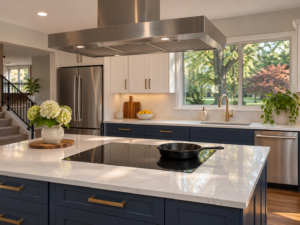
Induction in a Kitchen Island
Putting the cooktop in an island is a popular layout in open kitchen plans. With induction, it is often more practical than with gas, since there is no open flame and the surface stays cooler. Still, plan for:
- Ventilation: island hoods or downdraft systems need ducting routed through the ceiling or floor.
- Electrical: the 240-volt circuit has to run under the floor or through the ceiling to the island.
- Safety and landing space: keep enough counter on each side of the cooktop for pots and pans.
- Seating: do not place stools directly behind the cooking zone.
Ventilation Still Matters
Induction does not burn gas, so there are no combustion byproducts from the cooktop itself. But cooking still produces steam, grease and odors. A properly sized range hood, ducted to the outside, keeps cabinets, ceilings and indoor air cleaner. Choose a hood that covers the cooking surface and has a capacity appropriate for how you cook. Your remodeler should plan the duct route before the ceiling is closed.
Cookware Compatibility
Induction works only with magnetic cookware. A simple test: if a magnet sticks firmly to the bottom of a pan, it will work. Cast iron and many stainless steel pans are compatible. Aluminum, copper and glass pans usually are not, unless they have a magnetic base.
Many homeowners replace a few pans when they switch. Factor that into the budget.
Cooktop or Range?
- Induction cooktop: sits in the counter, with storage or a wall oven elsewhere. Good for island layouts and custom kitchens.
- Induction range: cooktop and oven in one unit. Simpler for a standard kitchen layout.
- Combined layout: induction cooktop on the counter with a separate wall oven or speed oven.
The right choice depends on layout, cabinet design and how you cook.
Questions to Settle Before Ordering Cabinets
1. Which induction model or size will you install, and what is its cutout and circuit requirement?
2. Does the electrical panel have capacity, or does it need an upgrade?
3. How will the gas line be handled?
4. Where will the hood or downdraft ducting run?
5. What cabinets will hold the cooktop or range?
6. Will the countertop material work with the cutout and edge details?
7. Do you need new cookware?
Answering these before cabinets are ordered prevents costly changes later.
Common Mistakes to Avoid
- Choosing an appliance before confirming panel capacity.
- Forgetting ventilation because there is no flame.
- Ordering cabinets that do not match the appliance’s installation guide.
- Placing seating too close to the cooking zone in an island.
- Assuming all existing pots will work.
Countertops, Cutouts and Finishing Details
The countertop and the cooktop have to be planned together. Induction cooktops drop into a cutout sized by the manufacturer, and the countertop fabricator will need that specification before templating.
Points to confirm:
- Cutout size and corner radius from the appliance installation guide.
- Countertop material: quartz, granite and other stone tops all work with induction, but ask the fabricator about support around the cutout and any heat guidance from the countertop manufacturer.
- Flush or surface mount: some cooktops can be installed flush with the counter for a seamless look, which requires a precise routed ledge.
- Clearance below: drawers under a cooktop must leave room for the unit’s depth and any ventilation path the manufacturer requires.
- Controls: touch controls on the glass are common. Some models have knobs or controls on the front edge, which affects how they fit with cabinet fronts.
Living With Induction Day to Day
Homeowners who switch usually notice a few practical differences:
- Speed: water boils quickly, so recipes may need adjusting at first.
- Cleaning: spills do not bake onto the surface as easily, because the glass is not the heat source. A quick wipe is often enough.
- Noise: a light hum or fan sound is normal on many models, especially at high power settings.
- Pan size: pans should match the size of the cooking zone for best results.
- Power sharing: many cooktops share power between zones, so using the boost function on one may reduce power on another.
For families with young children, the cooler surface and automatic shutoff features found on many models add peace of mind. For serious home cooks, precise temperature control is often the main reason they never go back.
Frequently Asked Questions
Is induction worth it in a kitchen remodel? For many homeowners, yes. Induction heats quickly, is easy to clean and keeps the surface cooler. A remodel is the best time to make the switch because wiring and ventilation can be planned together.
Do I need a new electrical circuit for induction? Usually yes. Induction appliances typically require a dedicated 240-volt circuit sized per the manufacturer’s instructions. A licensed electrician should confirm.
Can I put an induction cooktop in an island? Yes, with planning for electrical, ventilation and safe clearances.
Do I still need a range hood with induction? Yes. Cooking still produces steam, grease and odors, so a ducted hood remains important.
Will my current pots work? Only if they are magnetic. Test them with a magnet.
If you are planning a kitchen remodel in Huntingdon Valley and want to switch to induction, Huntingdon Valley Kitchen & Bath Remodelers LLC can help you plan the layout, cabinets, electrical coordination and ventilation together. Learn more about our kitchen remodeling services in Huntingdon Valley and schedule a design consultation.